









-
Cooking smells are welcome during a meal and much less welcome two hours later. Fish, curry, garlic, frying oil, and the general buildup of cooking residue in kitchen air can linger far longer than expected. Add in gas stove combustion byproducts or smoke from high-heat cooking, and kitchen air quality takes a real hit.
An air purifier with a good activated carbon filter layer handles this better than a range hood alone. Range hoods mostly deal with steam and some grease particles, but do little for odors that have already spread into the rest of the room.
What Makes an Air Purifier Work for Kitchen Odors

-
For kitchen odors specifically, the filtration priority shifts compared to an allergy purifier. Odors and cooking gases are volatile organic compounds (VOCs) and chemical gases that HEPA filters do not capture. Carbon filters do.
Activated carbon adsorbs odor molecules and VOCs, binding them to the carbon surface and removing them from circulation. More carbon capacity means more odor-absorbing ability and longer filter life before saturation. HEPA filtration handles cooking smoke particles, grease particles, and fine particulate matter from gas stoves. Both layers together provide the most complete kitchen air cleaning.
#1. Blue Pure 211i Max with SmokeBlock Filter (Best for Serious Cooking Odors)

-
For a kitchen connected to a dining room or open-plan living space (which most modern homes have), a large-room air purifier is necessary. The Blue Pure 211i Max covers up to 674 sq ft with a CADR of Pollen 450 cfm, Dust 452 cfm, and Smoke 435 cfm, making the unit the right scale for an open kitchen-living area.
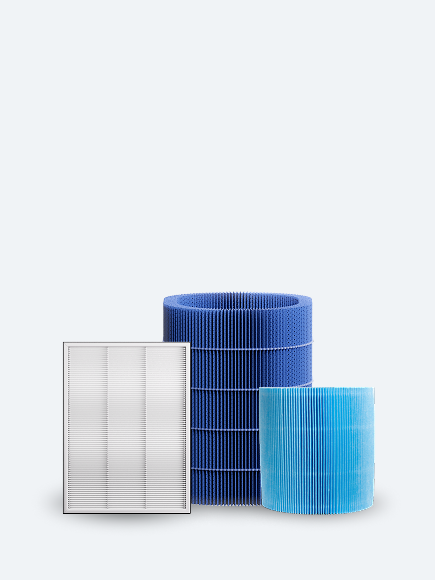
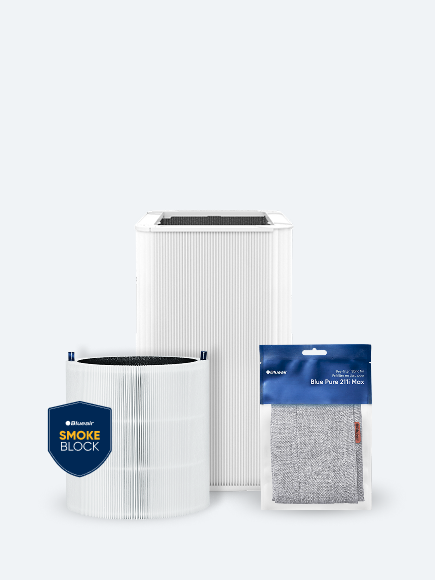
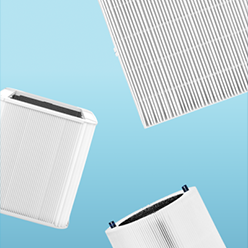
Pairing the 211i Max with the SmokeBlock filter, which contains 2x more activated carbon than the standard Particle + Carbon filter, is the recommended approach for kitchen use. Extra carbon surface area means more odor molecules captured, and a longer time before the filter saturates with kitchen smells. HEPASilent™ filtration handles fine cooking particles alongside odor absorption.
Auto mode with PM2.5 sensors picks up smoke and particulate spikes from high-heat cooking automatically and ramps up fan speed in response.
#2. Blue Pure 311i+ Max with SmokeBlock Filter (Best for Smaller Kitchens)

-
For a separate kitchen or a smaller space under 525 ft², the Blue Pure 311i+ Max is the better-sized option. A CADR of Pollen 446 cfm, Dust 370 cfm, Smoke 339 cfm, GermShield technology, voice control via Alexa and Google Assistant, auto mode, and compatibility with the SmokeBlock filter for extra carbon capacity. A filter subscription saves 15% on every replacement.
#3. Blue Signature (Best Premium Pick for Open Plans)

-
For a large open kitchen-dining-living space, the Blue Signature covers up to 705 sq ft with a CADR of 455 CFM for smoke and 434 CFM for dust. OdorFence Technology provides 10x more odor removal compared to standard filtration. Seven stages of filtration and a premium activated carbon layer make the unit genuinely outstanding for kitchen odors in large open-plan homes. A patent-pending filter design also doubles filter lifetime compared to previous Blueair models.
#4. Austin Air HealthMate HM400 (Best for Heavy-Duty Odor Control)
For households where particularly strong cooking happens daily (heavy fish cooking, frequent deep frying, daily aromatic spice use), the Austin Air HealthMate takes carbon capacity to another level: 15 lbs of activated carbon and zeolite. No smart features, no app, no auto mode, just raw filtration power with a 4-stage system including medical-grade HEPA. The manufacturer rates filter life at up to 5 years under normal residential use, though heavy kitchen odor loads may shorten that. Coverage is rated for rooms up to 1,500 sq ft on the highest of three fan speeds.
#5. Coway Airmega AP-1512HH Mighty (Best Budget Kitchen Pick)
The Coway Mighty has a 4-stage filtration system, including a deodorization filter anda True HEPA filter that handles moderate kitchen odors in rooms up to 361 sq ft. Not a heavy-duty odor solution, but capable for a smaller kitchen with standard cooking smells. An air quality indicator shows when particle levels from cooking spike, and auto mode adjusts fan speed in response. CADR ratings sit at 246 CFM for dust, 240 for pollen, and 233 for smoke.
Range Hoods and Air Purifiers Work Best Together
Range hoods pull steam, grease, and some smoke directly out of the air above the cooktop. An air purifier in the kitchen or adjacent open living area catches what the range hood misses: odors that have already diffused into the room, fine particles that circulate in the broader space, and VOCs from gas stoves.
Running both is the most effective approach. For households that cook heavily and can only invest in one, a well-vented range hood that exhausts to the outside comes first, then an air purifier for the remaining odor and particle load.
According to the EPA, VOC levels indoors can be significantly elevated during and after cooking activities. An activated carbon air purifier meaningfully reduces that exposure.
Placement Tips for Kitchen Air Purifiers

-
In an open-plan kitchen-living area, positioning the purifier between the kitchen and living space helps intercept odors as they travel. For a separate kitchen, placement within the room itself but away from direct cooktop heat works best. Running the unit on high speed while cooking, then switching to auto mode for cleanup afterward, is the most efficient approach. Smart models like the Blue Pure 211i Max detect cooking-related particle spikes and respond automatically through auto mode.
FAQs
Do air purifiers remove cooking smells?
Yes, when equipped with an activated carbon filter. Carbon adsorbs odor-causing VOC molecules from cooking. HEPA alone does not capture gaseous odors, so the carbon layer is essential for kitchen use.
What kind of filter works best for kitchen odors?
An activated carbon layer is essential. More carbon capacity means better odor absorption and longer filter life. The SmokeBlock filter has twice the carbon of the standard filter and is a strong upgrade for kitchen use.
Can an air purifier replace a range hood?
No. A range hood vented to the outside handles grease, steam, and combustion products at the source. An air purifier handles what spreads into the broader room. Both together provide the most complete coverage.
Are gas stoves worse for indoor air quality than electric ones?
Yes. Gas stoves produce nitrogen dioxide and carbon monoxide as combustion byproducts, even during normal use. An air purifier with a carbon filter helps manage VOC levels, though proper kitchen ventilation remains the most important first step. For help choosing the right model, the Blueair guided selling tool matches room size and needs in about a minute.