













-
Unpleasant odors can make your home feel less comfortable, whether from cooking, pets, smoke, or everyday household activities. Many people wonder if air purifiers can actually remove these smells or just mask them temporarily.
The short answer is yes, air purifiers can remove smells and odors, but not all air purifiers are created equal. Success depends entirely on the type of filtration technology inside the unit. Understanding how your air purifier tackles odors will help you choose the right solution for your home.
How Air Purifiers Remove Odors and Smells
Air purifiers work by pulling air through a series of filters that trap particles and gases. While many people associate air purifiers with removing allergens like pollen and dust, odor removal requires a different approach.
Most odors are caused by volatile organic compounds (VOCs) and other gaseous molecules that float through the air. According to the EPA, VOC concentrations are consistently higher indoors than outdoors, often two to five times greater. Standard particle filters alone cannot capture these tiny gas molecules. A comprehensive systematic review of 148 field studies published in Science of the Total Environment found that air purifiers show very little effectiveness at reducing gaseous pollutants when relying solely on particle filtration, which is why activated carbon filtration becomes essential for odor removal.[1]
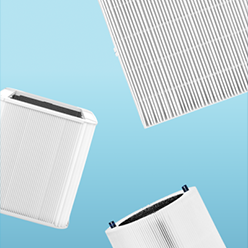
The key is activated carbon filtration. Activated carbon has been treated to create millions of microscopic pores, giving it an enormous surface area relative to its size. As air passes through your air purifier, odor-causing gases adhere to the carbon surface through a process called adsorption. The molecules stick to the carbon rather than passing back into your air.
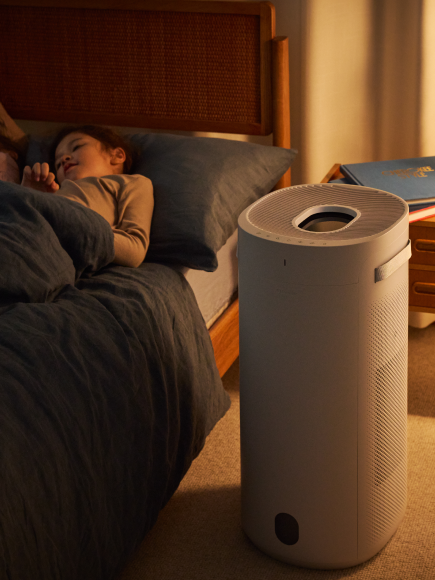
Blueair air purifiers combine HEPASilent™ technology with activated carbon filters to address both particles and odors simultaneously. HEPASilent™ technology captures 99.97% of airborne particles down to 0.1 microns while using minimal energy, making it an efficient solution for comprehensive air care.
What Types of Household Odors Can Air Purifiers Remove?

-
Your air purifier, equipped with proper filtration, can tackle a wide range of household odors. Here are the most common types:
Pet Odors in Your Home
Pet smells come from multiple sources, including dander, hair, saliva, urine, and general pet accidents. Over time, pet dander breaks down and releases VOCs that contribute to lingering odors.
An effective air purifier needs both particle filtration for dander and hair, plus activated carbon for the gaseous odor compounds. Running your air purifier continuously in rooms where pets spend the most time helps maintain fresher air. Explore Blueair's pet-focused air purification solutions to find options that work with your household.
Cooking Smells Eliminated by Air Purifiers
Strong cooking odors from fish, garlic, spices, and fried foods can linger long after meal preparation ends. Cooking releases both particles (grease, smoke) and gases (aromatic compounds).
Activated carbon filters in air purifiers excel at adsorbing these food-related VOCs. For best results, position your air purifier in or near the kitchen, though not directly next to the stove, where grease could clog the filters prematurely.
Smoke Odors and Air Purifiers
Cigarette smoke, wildfire smoke, and other combustion odors contain both fine particles and gaseous compounds. Smoke particles are particularly small and can penetrate deep into furniture, carpets, and walls.
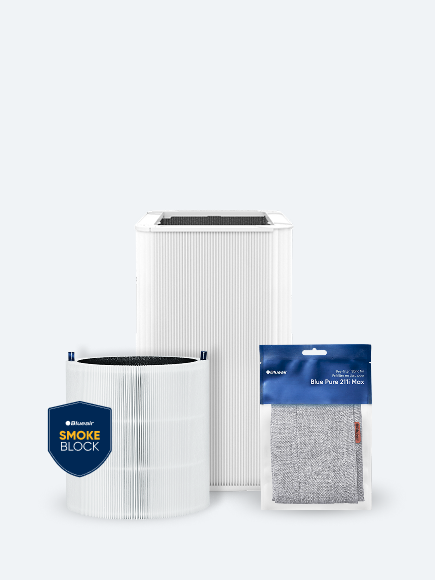
A combination of HEPA-type filtration and activated carbon is essential for smoke removal from your air purifier. The particle filter captures the fine smoke particles, while the carbon layer adsorbs the odor-causing gases. Learn more about how air purifiers handle smoke and discover specialized smoke-fighting filters available for Blueair purifiers.
Chemical and Household Odors Removed by Air Purifiers
Cleaning products, paints, new furniture, air fresheners, and personal care products all release VOCs into your home air. Some of these chemicals can linger for weeks or months after initial use.
Activated carbon filtration is particularly effective against these chemical odors because carbon naturally attracts and holds organic compounds. If you've recently painted a room or brought home new furniture, running your air purifier can significantly reduce the off-gassing smell.
Mold and Mildew Odors in Your Home
Musty smells from mold and mildew indicate excess moisture and biological growth. While your air purifier can remove mold spores from the air and reduce the associated odor, addressing the moisture source is critical for long-term success.
Air purifiers complement but do not replace proper mold remediation and humidity control.
Important Limitations to Understand About Air Purifiers and Odors
Air purifiers are powerful tools for odor control, but understanding their limitations helps set realistic expectations.
Carbon filters have a lifespan
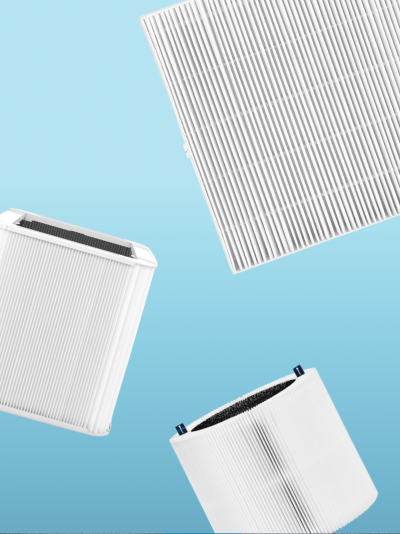
Unlike HEPA filters, which can trap particles indefinitely until airflow is restricted, activated carbon fills up with adsorbed gases over time. Once saturated, carbon filters in your air purifier lose effectiveness. Most need replacement every three to six months, depending on odor levels.
Air purifiers address airborne odors only
Smells embedded in carpets, upholstery, curtains, and walls require cleaning or other removal methods. Your air purifier prevents odors from continuing to circulate, but cannot extract smells already absorbed into materials.
Source control matters
Air purifiers work best as part of a comprehensive odor management strategy. Regular cleaning, proper ventilation, addressing spills promptly, and fixing moisture problems will always be necessary. Air purifiers enhance these efforts rather than replace them.
Room size affects air purifier performance
Every air purifier is rated for a specific room size based on air changes per hour. Using an undersized unit in a large space reduces effectiveness. Check the manufacturer's recommendations to ensure proper coverage.
Choosing the Right Air Purifier for Odor Removal

-
When selecting an air purifier specifically for odor control, prioritize these features:
Activated carbon filter
Non-negotiable for odor removal. Look for substantial carbon weight, not just a thin carbon pre-filter. Some units list carbon filter weight in the specifications.
Appropriate room coverage
Match your air purifier's rated square footage to your room size. For strong or persistent odors, consider a unit rated for slightly larger spaces to increase the air change rate.
CADR ratings
Clean Air Delivery Rate indicates how quickly your air purifier can clean air. Higher CADR numbers mean faster odor removal, especially important for smoke.
Filter replacement indicators
Built-in alerts help you change carbon filters before they become saturated and ineffective.
Quiet operation
Since odor control often requires continuous operation of your air purifier, noise level matters. Blueair's air purifiers are engineered for efficient, quiet performance suitable for bedrooms and living spaces. It's worth noting that some air cleaning technologies beyond standard HEPA and carbon filtration such as photocatalytic oxidation (PCO) and plasma systems may generate unwanted by-products like formaldehyde or ozone as a side effect of their operation.[1]
Energy efficiency
Running your air purifier full-time for odor control shouldn't spike your electricity bill. Blueair units consume minimal electricity, making continuous operation practical and affordable.
Breathe Easier with Clean Air
Ready to tackle household odors once and for all? Explore Blueair's air purifiers featuring HEPASilent™ technology and activated carbon filtration. Our Swedish-engineered units deliver cleaner air quietly and efficiently, helping you and your family breathe easier at home.
FAQs
Q. Can air purifiers remove all household odors?
Air purifiers with activated carbon filters can remove most airborne odors from pets, cooking, smoke, and chemicals. However, odors absorbed into fabrics, carpets, and walls require cleaning. Your air purifier prevents circulating odors but works best combined with regular cleaning and source control.
Q. How long does it take for an air purifier to remove smells?
The time varies based on odor intensity, room size, and purifier strength. Mild odors may clear within an hour, while strong smells like smoke or paint fumes might take several hours or days of continuous operation. Proper room sizing is critical for faster results.
Q. What's the difference between HEPA filters and activated carbon for odors in air purifiers?
HEPASilent™ in your air purifier captures solid particles like dust, pollen, and pet dander, but cannot trap gaseous odor molecules. Activated carbon filters specifically target gases and VOCs through adsorption. Effective odor removal requires both filter types working together in your air purifier.
Q. How often should I replace carbon filters in my air purifier?
Most activated carbon filters need replacement every three to six months, depending on odor levels and usage. Heavy odor environments require more frequent changes. When you notice smells returning despite your air purifier running, the carbon filter is likely saturated. Shop replacement filters for your air purifier and consider filter subscription options for convenience.
Q. Will an air purifier help with the cigarette smoke smell?
Air purifiers with both HEPA-type filtration and substantial activated carbon can significantly reduce cigarette smoke odor and particles. However, smoke residue on surfaces will require cleaning. For best results, run your air purifier continuously and replace filters regularly.
References
[1] Ebrahimifakhar, A., Poursadegh, M., Hu, Y., Yuill, D. P., & Luo, Y. (2024). A systematic review and meta-analysis of field studies of portable air cleaners: Performance, user behavior, and by-product emissions. Science of The Total Environment, 912, 168786. https://doi.org/10.1016/j.scitotenv.2023.168786