









-
HEPA Filters and the 0.3 Micron Standard
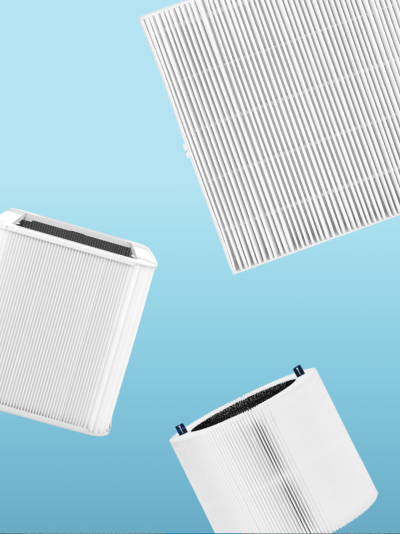
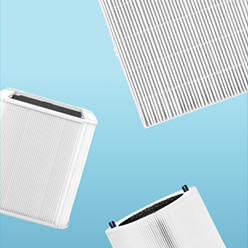
A HEPA filter is a dense, pleated mat of fine fibers that captures airborne particles in the air. According to the EPA and the U.S. Department of Energy, a HEPA filter removes at least 99.97% of particles 0.3 microns in diameter, including dust, pollen, mold, and bacteria. The sections below explain the definition, capture mechanics, and limitations of HEPA filters.
What Does HEPA Stand For?
HEPA is an acronym for high efficiency particulate air. There are different grading systems in the US and Europe. Europe's EN 1822 standard sorts filters into classes instead of a single definition, and only the H13 and H14 classes count as HEPA. The H13 class translates to 99.95% filtration efficiency at the most penetrating particle size. Some marketing labels sit outside both systems, and there is no medical grade HEPA filter class in the United States.

-
How Do HEPA Filters Work?
A HEPA filter has deep pleats and far more surface area than a conventional pleated filter, according to the EPA. Air flows through a tangled web of fibers, and particles are captured by direct contact with those fibers. Research from NASA Glenn Research Center names three main capture mechanisms in these filters: diffusion, interception, and inertial impaction. Each one works best on a different particle size.
Impaction: The largest, heaviest particles in the air are usually caught in the fiber. As the air bends around the fibers in the filters, the momentum of heavy particles makes them strike the fiber and stick to it.
Interception: Mid-sized particles are light enough to follow the airflow, but they still end up brushing against a fiber. When a particle touches the fiber surface, it is held there.
Diffusion: The smallest particles, from the nanometer to the submicron range, are hit by collisions with air molecules (Brownian motion). This results in a random zigzag movement, making them likely to hit a fiber before they can escape the filter. This is why HEPA media is very efficient at catching ultrafine particles.
What Do HEPA Filters Remove, and What Do They Miss?
HEPA filters target airborne particles, including dust, pollen, mold spores, pet dander, bacteria, and fine particles in smoke. The EPA notes that most filters target either particles or gases, and recommends an air cleaner with an activated carbon filter designed for gases to reduce VOCs and odors, which is separate from airborne particles. A HEPA filter alone will not remove cooking smells or fumes from paint, which is why many purifiers stack a carbon layer behind the particle media.
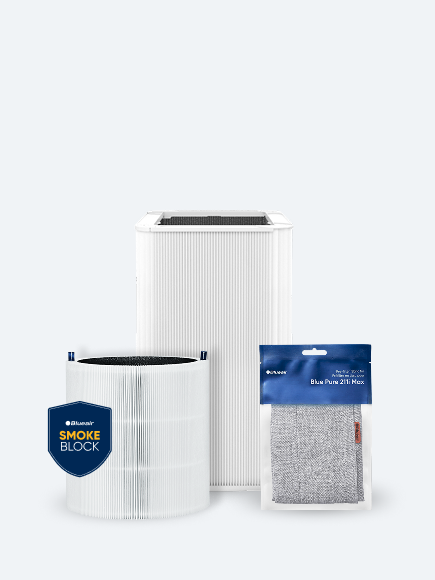
In the Blueair lineup, the Blue Pure 211i Max includes a Particle & Carbon filter for everyday particles and light household odors. For even heavier smells, Blueair’s SmokeBlock filter uses 2x more activated carbon than standard filters and targets smoke, smog, and other strong odors like pets’. Blueair’s guide to air purifiers with activated carbon filters covers that pairing in detail.
How Does Blueair HEPASilent™ Technology Work?
Blueair air purifiers use HEPASilent™ technology, which combines electrostatic and mechanical filtration to capture tiny airborne pollutants like pollen, dust, and smoke. Particles drawn into the purifier are given an electrostatic charge so they cling to the filter more readily. This differs from ionization-only devices because the charged particles are captured by filter media inside the unit. To learn more about HEPASilent™ technology, see how HEPASilent™ differs from HEPA and HEPASilent™ testing against the HEPA definition. For a wider look at purifier technologies, including carbon and UV-C, see how air purifiers work.
Two models show how the filter and room size come together. The Blue Pure 211i Max is built for large rooms, with a recommended room size of 674 sq ft, a Particle & Carbon filter for everyday particles and light household odors, and RealTrack™ filter-life tracking. The Blue Signature™ Large is recommended for rooms around 705 sq ft and adds OdorFence Technology™ for common odor gases.
How CADR and Room Size Affect HEPA Performance
The EPA advises choosing a portable air cleaner with a CADR large enough for the room, and points out that higher fan speeds and longer run times increase the amount of air filtered. For the smallest particles, the EPA suggests looking for a high CADR for tobacco smoke.
The EPA's Guide to Air Cleaners in the Home gives these minimum CADR figures for particle removal, based on an 8-foot ceiling:
Minimum CADR by Room Size