













-
Key Takeaways
- Carbon captures gases through adsorption. Activated carbon holds gas and vapor molecules on its surface, so an air purifier still needs a particle filter for dust, pollen, and smoke particles.
- Surface area does the work. Processing fills the carbon with tiny pores, which gives it a very high internal surface area.
- Some gases are a better match than others. The EPA lists most hydrocarbons, many aldehydes, and organic acids as good targets, and low-molecular-weight aldehydes such as formaldehyde, ammonia, and hydrogen sulfide as weak ones.
- The amount of carbon is the spec to check. The EPA says carbon filters can be effective when they hold a large amount of material, and no widely used rating exists for gas removal, since CADR covers particles only.
- Carbon fills up over time. Sorbent filters need regular replacement before gases start passing through, so replacement follows the manufacturer’s schedule.
What Is Activated Carbon?
Carbon air filters include activated carbon. Activated carbon, also called activated charcoal, is carbon processed to be extremely porous. Manufacturers start with a carbon-rich material such as coconut husk, wood, or coal, heat it in a low-oxygen environment to char it, then activate it with steam or chemicals to open up a network of microscopic pores. Those pores give it a very high surface area, which the EPA identifies as what lets sorbent filters such as activated carbon capture gas and vapor molecules.
How Does a Carbon Air Filter Work?
Inside a carbon filter, carbon air filters capture molecules through adsorption, which is the physical attraction of gas or vapor molecules to a surface. As air flows through the carbon, molecules from odors and VOCs cling to the pore walls and are held out of the airstream. Adsorption is easy to confuse with absorption. A sponge absorbs water into its whole volume, while activated carbon holds molecules on its surfaces, including the inner walls of every pore.
Some filters add a second process called chemisorption, in which the carbon is coated with reactive compounds that bond chemically with certain gases. According to the EPA, adsorption happens more readily at lower temperatures and humidity, and a carbon filter tends to capture the molecules it has the greatest affinity for and let others stay in the air.

-
What Do Carbon Air Filters Remove?
- Strong matches. Activated carbon can remove most hydrocarbons, many aldehydes, and organic acids through adsorption, and ozone through chemisorption.
- Household VOCs. Paints, varnishes, and many cleaning products contain organic solvents that release VOCs, and the EPA points people who want a portable air cleaner for VOCs toward activated carbon or another filter designed for gases.
- Weak matches. Activated carbon is not especially effective against low-molecular-weight aldehydes such as formaldehyde, ammonia, hydrogen sulfide, sulfur oxides, or nitrogen oxide.
- Particles. Activated carbon targets gases, so dust, pollen, pet dander, and the fine particles in smoke call for a particle filter.
Why Carbon Filters Work Alongside a Particle Filter
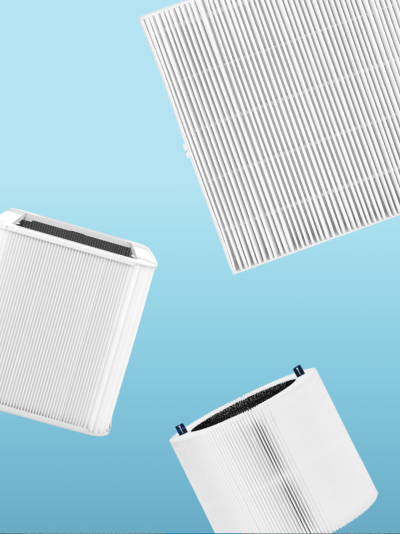
Indoor air usually carries particles and gases at the same time. Most filters are designed for one or the other, which is why many air purifiers contain two filters: one for particles and one for gases.
The order of the filters matters as well, and filters containing sorbents such as carbon should generally sit downstream of the particle filter, which reduces the amount of particulate matter that reaches the carbon.
Blueair Air Purifiers with Activated Carbon
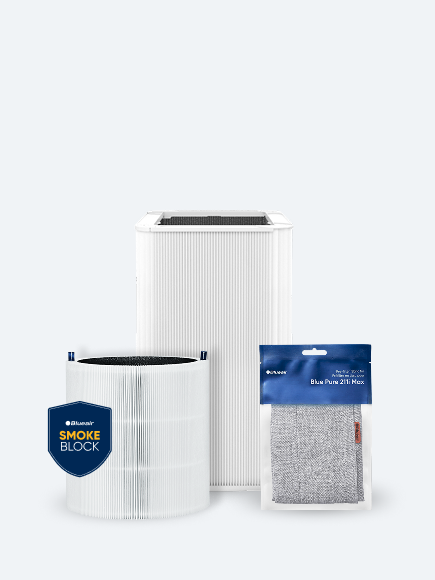
Blueair combines HEPASilent™ particle filtration with activated carbon. The Blue Pure 211i Max ships with a Particle & Carbon filter for everyday particles and light household odors. For heavier loads, the optional SmokeBlock filter uses 2x more activated carbon than the standard filter and targets smoke, smog, and stronger odors.
Blue Signature™ uses OdorFence Technology™, which captures common odor gases and breaks them down. It uses seven stages of filtration and comes in Small, Medium, and Large sizes, recommended for rooms of about 248, 498, and 705 sq ft. For cooking, pet, and smoke smells room by room, Blueair's guide to air purifiers with activated carbon filters for home odors walks through placement and filter choice.
How to Choose a Carbon Air Purifier
Start with what is in the air. Carbon suits VOCs and odors from sources such as paint, cleaning products, and cooking, while a home dealing mostly with dust and pollen needs strong particle filtration first. Then check how much carbon the filter holds.
Size the purifier to the space with Blueair's guide to room size, and keep ventilation and source control in the plan, since the EPA says filtration doesn't replace them. Compare Blueair air purifiers for odor to find a carbon filter that fits the room.
Frequently Asked Questions
Is activated carbon the same as charcoal?
Not quite. Activated carbon is also called activated charcoal, but it goes through an activation step that opens up far more pore surface than ordinary charcoal has, and that surface is what lets it adsorb gases.
Do carbon air filters remove VOCs?
Many of them. The EPA recommends activated carbon or another gas filter for portable air cleaners meant to remove VOCs, and its technical summary notes that carbon is not especially effective against low-molecular-weight aldehydes such as formaldehyde and a few other gases.
Do carbon filters remove smoke?
Partly. Activated carbon targets the gases behind smoke odor, and a particle filter captures the smoke particles, so a purifier for smoke needs both. Blueair's guide to wildfire smoke and air purifiers covers purifier choice when smoke is the main concern.
How long does a carbon air filter last?
It depends on how much carbon the filter holds and how much gas it meets. Blueair rates Blue Pure 211i Max filters for up to 9 months.