











-
A great air purifier placed in the wrong spot will clean a small pocket of air while the rest of the room stays stagnant. Where the unit sits changes how effectively it circulates and filters the air, especially in a bedroom where someone is breathing the same air for eight hours straight.
Here are the five best placement positions, ranked by effectiveness.
Where to Put an Air Purifier in a Bedroom
Placement #1: Near the Head of the Bed (Best for Sleep)

-
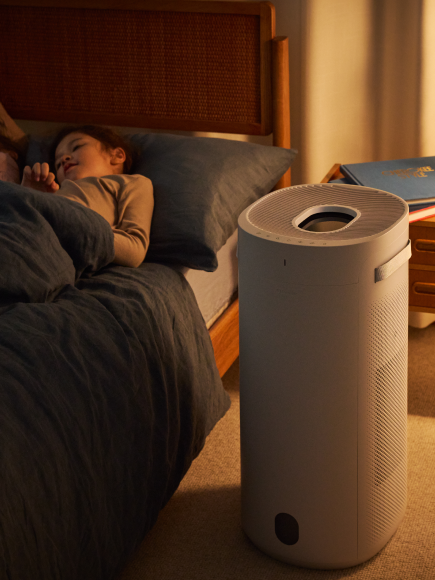
For a bedroom, the goal is clean air right where breathing happens for eight hours a night. Placing the purifier on a nightstand or dresser near the head of the bed, roughly 3 to 5 feet away, means the cleanest air the unit produces flows toward the sleeper.
Pointing the airflow directly at someone's face is not ideal. A slight angle or positioning the unit so air flows across the bed rather than straight onto the pillow is more comfortable and equally effective.
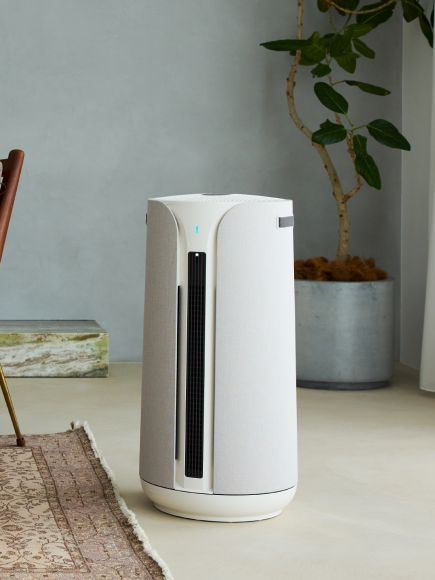
The Blue Pure 511i Max works well on a nightstand for exactly this reason. At just 4.2 lbs, the unit is compact enough for a dresser top, runs as quietly as 19 dB on its lowest setting, and covers rooms up to 237 sq ft with full smart control through the Blueair app.
Placement #2: Elevated, Not on the Floor

-
Air purifiers work better when elevated. Ground-level placement means the unit pulls in and pushes out air near the floor, where circulation is often the weakest. An elevated position, on a nightstand, dresser, or small table, puts the intake and outlet in the breathing zone where people actually spend time.
For larger units that are too heavy for a dresser, floor placement near the center of the room and away from walls is the next best option. More on choosing the right air purifier based on room size can help determine whether a compact elevated model or a larger floor unit is the better fit.
Placement #3: Toward the Center of the Room, Not in a Corner

-
The corner of a bedroom might seem like a tidy, out-of-the-way spot, but corners have the least air circulation in any room. Air does not flow through corners efficiently, so a purifier stuck in one mostly cleans the air immediately around itself.
Position the unit toward the center of the room, or at least a foot or two away from walls. Air moves better in open space, and that is where a bedroom air purifier will do the most good. Blue Pure models pull air in from 360 degrees around the base and push clean air out through the top, so leaving clearance on all sides is especially important.
Placement #4: Near the Bedroom Door (Best for Allergen Control)

-
Allergens like pollen and pet dander enter the bedroom from other parts of the house. Placing the purifier near the bedroom door intercepts that incoming air before particles circulate through the space. For families with pets that do not sleep in the bedroom, this placement creates a cleaner air zone before pollutants get in.
Pair this with keeping the bedroom door closed as much as possible. A HEPA air purifier placed near the door essentially acts as a first line of defense against allergens from the rest of the home.
Placement #5: Away from Electronics and Competing Airflow

-
Keep the air purifier at least a foot or two away from televisions, computers, and fans. Electronics can interfere with air quality sensors on smart models, and fans or heating vents create competing airflow that reduces the purifier's ability to circulate air through its filters effectively.
Similarly, keep the unit away from curtains or fabric that could restrict airflow around the intake vents. Blocked sides reduce performance significantly, especially on models with 360-degree air intake.
Additional Placement Tips

-
Keep the door closed. An air purifier sized for a 300 sq ft bedroom will struggle if the door is open to a 1,000 sq ft hallway. Closed doors let the unit efficiently cycle and clean the air within the defined space. According to the EPA, portable air cleaners are most effective when used in enclosed spaces with doors and windows closed.
Do not block air intake or outlet vents. A book, lamp, or plant placed too close to the intake will restrict airflow and reduce efficiency. Leave at least 1 to 2 feet of clearance around all sides of the unit.
Running a purifier and humidifier together is fine, but space them apart. Placing an air purifier directly next to a humidifier where mist blows into the intake vents creates unnecessary strain on the filter. Position the two devices on opposite sides of the room for the best results. For anyone who wants both functions without managing placement of two separate devices, a combination air purifier and humidifier handles both in one footprint.
Consider where the most time is spent. For anyone who also works at a desk in the bedroom during the day, position the purifier near the desk during work hours and move it back near the bed at night. The Blue Pure 511i Max at 4.2 lbs is light enough to reposition in seconds.
What If the Bedroom Is Large?
For bedrooms over 400 sq ft, a smaller air purifier is not going to cover the whole space effectively. Either size up to a unit that matches the room, like the Blue Pure 311i+ Max for rooms up to 465 sq ft, or run two smaller units on opposite sides. Two well-placed units will outperform one undersized unit working at maximum capacity and producing more noise.
Quick Placement Checklist
Use an elevated position, not the floor. Place 3 to 5 feet from the head of the bed. Keep the unit away from corners and walls with 1 to 2 feet of clearance on all sides. Position near the bedroom door if incoming allergens are the main concern. Keep the bedroom door closed while running. Place away from electronics and competing airflow sources.
Placement does not need to be complicated. The goal is to give the purifier room to breathe and position it where the clean air reaches the sleeper directly. Getting those two things right delivers a noticeable difference from the first night.
FAQs
Should an air purifier be on the floor or elevated?
Elevated is generally better. Air a foot or two off the ground is less stagnant. A nightstand or dresser is ideal for smaller units. Larger units on the floor work fine with clear intake clearance.
How close should an air purifier be to my bed?
Within 3-6 feet of the head of your bed is the sweet spot. Close enough to directly filter your breathing zone, but not so close that fan noise is disruptive.
Can I put an air purifier in the corner of the bedroom?
Technically, yes, but a corner is the worst airflow position in a room. Air is most stagnant there. Place it along an open wall or near the center of the room for better performance.
Is it okay to run an air purifier all night?
Absolutely, and it's actually the best way to use it in a bedroom. Modern air purifiers on low or night mode are very quiet and energy-efficient. Consistent overnight operation keeps air quality at its best while you sleep.
Should I close the bedroom door when running the air purifier?
Yes. A closed room allows the purifier to cycle the same air repeatedly, achieving higher effective filtration. An open door means it's trying to filter a much larger volume of air than it's rated for.
Does placement affect how loud the air purifier is?
Yes. Sound bounces more off walls and hard surfaces when the purifier is in a corner or against a wall. Some distance from walls, with soft furnishings in the room, helps dampen operational noise.